Monday, August 31, 2020

Using Variables - August 31st

Topics for Today:

Our Algebra lesson focused on some of the language of Algebra and how words can be translated into algebraic expressions.

A table listing different ways how to say or mean addition, subtraction,  multiplicatio… | Algebraic expressions, Introductory algebra, Writing  algebraic expressions


Vocabulary:  variable, algebraic expression, equation, open sentence


Sections Covered in Textbook:

1-1: Using Variables (Pages 4-8)


Resources & Tutorials:

1) What are numerical and algebraic expressions?
2) Translating mathematical expressions
3) Class Notes - Using variables


Assignments:

1) Using Variables Worksheet
2) Have course syllabus signed by Thursday
3) Join Google Classroom
* 7th Grade:  yytlrzo
* 8th Grade:  rhpuhky


Sunday, August 9, 2020

Welcome Back Students - August 2020

Hey Everyone!

I'm looking forward to the start of another amazing year at Field School.

Please bookmark this site as it will be your one-stop location for anything you need for Algebra I class this year!

GO FALCONS!


Every boy known, every boy a brother 


Tuesday, May 26, 2020

Exam Review - May 26th

Topics for Today:

Today we wrapped up our discussion of rational expressions and equations and discussed review topics for our final exam.  Those who have not completed the Delta Math assignment are strongly encouraged to do so.

Sections Covered in Textbook:

No new sections covered


Resources & Tutorials:

List of Exam Review Topics


Assignments:

1) Study for your final exam by completing this practice exam prior to Thursday's class.
2) If you have not done the Delta Math assignment, finish it.


Thursday, May 21, 2020

Adding and Subtracting Rational Expressions - May 21st

Topics for Today:

We will apply our knowledge of adding and subtracting fractions to the concept of adding and subtracting rational functions.  Recall that a rational function is just a "big fraction" - in more technical terms, a rational expression is a fraction containing polynomials in the numerator and denominator.  As with adding numeric fractions, adding rational expressions requires a common denominator, and we apply all the same rules.  To add or subtract fractions with common denominators, you will add or subtract their numerators, and keep the denominator the same.  Once you have performed the required operation, you should always make sure that your remaining fraction (or rational expression) is in simplest terms.


Sections Covered in Textbook:

12-6: Adding and Subtracting Rational Expressions (pages 667-670)
**We will only cover expressions with like denominators


Resources & Tutorials:

1) How do you add two rational expressions with the same denominator?
2) How do you subtract two rational expressions with the same denominator?
3) Class Notes on Adding and Subtracting Rational Expressions
4) Recording of Today's Class (see Google Classroom for password)


Assignments:

1) Adding and Subtracting Rational Expressions Worksheet
2) Review for Exam on Delta Math (due by Tuesday 5/26)


Wednesday, May 20, 2020

Dividing Polynomials - May 20th

Topics for Today:

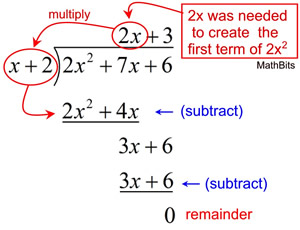
It may have been some time since you had to perform long division, and long division is a multi-step process like so many we have seen in Algebra.  If you follow the procedure, you will arrive at your answer (quotient).  The process for dividing polynomials is similar to long division of constants.

You should recall from earlier mathematics courses that the process for long division is as follows:

  1. Figure out how many whole times the divisor divides into the dividend and place that number on top of the divisor.
  2. Multiply this number by the divisor, and subtract this number from the dividend.
  3. Bring down the next number in the divisor. 
  4. Repeat until you have no more numbers in the dividend to bring down. 
  5. If your final subtraction problem results in "0", you have no remainder; otherwise, your remainder is a part of a whole and should be represented as a fraction with the remainder number in the numerator, and the divisor in the denominator.  
---> When dividing polynomials by a binomial, we will look to the variable part of the binomial to make our decision on what divides into the dividend.  


Sections Covered in Textbook:

12-5: Dividing Polynomials (pages 662-666)


Resources & Tutorials:

1) Review of Long Division
2) Dividing Polynomials (long division)
3) Cool Math - Dividing Polynomials Examples (not a video)
4) Dividing Polynomials Class Notes
5) Recording of today's lesson (see Google Classroom for password)


Assignments:

1) Dividing Polynomials Worksheet
2) Review for your Exam on Delta Math (due by Tuesday 5/26)


Tuesday, May 19, 2020

Multiplying and Dividing Rational Expressions - May 19th

Topics for Today:

Rational expressions can be multiplied or divided just like regular fractions. Recall from yesterday's lesson that a rational expression is just a fraction with polynomials in the numerator and denominator.  As with dividing regular fractions, when we divide rational expressions, we must multiply by the opposite of the divisor (invert and multiply, or as some of you like to say, keep, change, flip!)

We should always focus on taking out common factors as soon as we can.  This process helps to ensure that our eventual answer is in simplest terms.


Sections Covered in Textbook:

12-4: Multiplying and Dividing Rational Expressions (pages 657-661)


Resources & Tutorials:

1) Multiply and simplify rational expressions
2) How to divide rational expressions
3) List of More videos for multiplying and dividing rational expressions
4) Multiplying and Dividing Rational Expressions Class Notes
5) Watch a Recording of Today's Lesson (see Google Classroom for password)
6) List of Review Topics for Final Exam


Assignments:

1) Multiplying and Dividing Rational Expressions Worksheet
2) Exam Review on Delta Math


Monday, May 18, 2020

Simplifying Rational Expressions - May 18th

Topics for Today:

We will now encounter polynomials in our fractions.  A rational expression is just a ratio (fraction) with polynomials in the numerator and denominator.  When we want to simplify these fractions, we follow the same rules as for regular fractions: we need to divide out common factors from the numerator and denominator.  In order to simplify, we need to look at the greatest common factor (GCF) as well as other factoring tools.  We will factor both the numerator and denominator, and then see if we have any common factors that simplify to 1.


Sections Covered in Textbook:

12-3: Simplifying Rational Expressions (pages 652-656)


Resources & Tutorials:

1) What is a rational expression?
2) Simplify Rational Expressions by factoring
3) Simplifying Rational Expressions by using opposite binomials
4) Simplifying Rational Expressions Class Notes
5) Recording of today's lesson (see Google Classroom for password)
6) List of Exam Review Topics


Assignments:

1) Simplifying Rational Expressions Worksheet
2) Review for your Exam on Delta Math