Monday, May 25, 2026

Dividing Polynomials

Topics for Today:

It may have been some time since you had to perform long division, and long division is a multi-step process like so many we have seen in Algebra.  If you follow the procedure, you will arrive at your answer (quotient).  The process for dividing polynomials is similar to long division of constants.

You should recall from earlier mathematics courses that the process for long division is as follows:

  1. Figure out how many whole times the divisor divides into the dividend and place that number on top of the divisor.
  2. Multiply this number by the divisor, and subtract this number from the dividend.
  3. Bring down the next number in the divisor. 
  4. Repeat until you have no more numbers in the dividend to bring down. 
  5. If your final subtraction problem results in "0", you have no remainder; otherwise, your remainder is a part of a whole and should be represented as a fraction with the remainder number in the numerator, and the divisor in the denominator.  
---> When dividing polynomials by a binomial, we will look to the variable part of the binomial to make our decision on what divides into the dividend.  
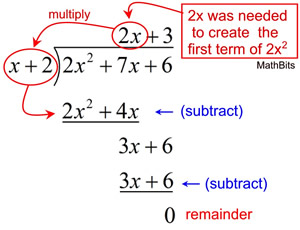

Sections Covered in Textbook:

12-5: Dividing Polynomials (pages 662-666)


Resources & Tutorials:

1) Review of Long Division
2) Dividing Polynomials (long division)
3) Cool Math - Dividing Polynomials Examples (not a video)


Wednesday, May 20, 2026

Multiplying and Dividing Rational Expressions

Topics for Today:

Rational expressions can be multiplied or divided just like regular fractions. Recall from yesterday's lesson that a rational expression is just a fraction with polynomials in the numerator and denominator.  As with dividing regular fractions, when we divide rational expressions, we must multiply by the opposite of the divisor (invert and multiply, or as some of you like to say, keep, change, flip!)

We should always focus on taking out common factors as soon as we can.  This process helps to ensure that our eventual answer is in simplest terms.


Sections Covered in Textbook:

12-4: Multiplying and Dividing Rational Expressions (pages 657-661)


Resources & Tutorials:

1) Multiply and simplify rational expressions
2) How to divide rational expressions
3) List of More videos for multiplying and dividing rational expressions


Tuesday, May 19, 2026

Simplifying Rational Expressions

Topics for Today:

We will now encounter polynomials in our fractions.  A rational expression is just a ratio (fraction) with polynomials in the numerator and denominator.  When we want to simplify these fractions, we follow the same rules as regular fractions: we need to divide common factors from the numerator and denominator.  To simplify, we need to look at the greatest common factor (GCF) as well as other factoring tools.  We will factor both the numerator and denominator, and then see if we have any common factors that simplify to 1.


Sections Covered in Textbook:

12-3: Simplifying Rational Expressions (pages 652-656)


Resources & Tutorials:

1) What is a rational expression?
2) Simplify Rational Expressions by factoring
3) Simplifying Rational Expressions by using opposite binomials


Monday, May 18, 2026

Inverse Variation

Topics for Today:

Inverse variation is another relationship between the x and y variables.  Inverse variation is defined by the relationship:

xy = k where k ≠ 0

As with direct variation, k is our constant of variation.  The shape of the inverse variation graphs are much different from what we've seen so far.  These graphs are a curved shape, and the larger the constants of variation, the further it moves from the origin.  There are boundaries with these functions that will be discussed in your Algebra II course.


Vocabulary:  constant of variation, inverse variation


Sections Covered in Textbook:

12-1: Inverse Variation (pages 636-642)


Resources & Tutorials:

1) What is inverse variation? 
2) How do you use the formula for inverse variation to write an equation?


Thursday, May 14, 2026

Direct Variation

Topics for Today:

Although we discussed direct variation several months ago, as we discuss related topics, I felt it was a good idea to revisit this topic.  Direct variation refers to how two variables are related to each other.  In algebraic terms, a function in the form of y = kx, where k ≠ 0, is a direct variation.

This function is similar to our slope-intercept form of a line (y = mx +b).

For direct variations, there is no y-intercept, and all of these functions must pass through the origin (0, 0).  We are effectively dealing with part of our slope-intercept form, y = mx.

For direct variations, we use the variable "k" to represent the slope, which is also our constant of variation.


Vocabulary:  direct variation, constant of variation

Sections Covered in Textbook:

5-5: Direct Variation (pages 261-266)


Resources & Tutorials:

1) What is the formula for direct variation?
2) What is the constant of variation?
3) How do you use the formula for direct variation?
4) Direct Variation Class Notes
5) Lego Prices Desmos Activity - Class Code U5Q99S


Solving Radical Equations

Topics for Today:

We added to our equation solving tools today by working with equations containing radicals.  To solve these equations, we must isolate the variable on one side of the equation.  Once we do that, we can "undo" taking a square root by squaring both sides.  We must be careful when squaring equations so that our process does not result in extraneous (extra) solutions.  It's always best to check our solutions to make sure they satisfy the original equation.  As with many other equation types, we may have a situation where our equation has no solutions.  In Algebra I, we do not work with imaginary numbers (in our class they are the square roots of negative numbers), so if we encounter any of these, our equation has no real solution.


Vocabulary: radical equation, extraneous solution

Sections Covered in Textbook:


11-5: Solving Radical Equations (pages 607-612)

Thursday, May 7, 2026

Operations with Conjugates and Other Roots

Topics for Today:

We finished our discussion of operations with radical expressions today with a method to simplify fractions with radical operations in the denominator.  We discussed the topic of conjugates to rationalize denominators that fall into this category.

We also discussed different roots other than square roots, and how to find them.


Vocabulary:  conjugate, cube root

Sections Covered in Textbook:

11-4:  Operations with Radical Expressions (pages 600-605)
**Other Root Functions are not in our book.


Resources & Tutorials:

1) Divide by Conjugate Method
2) Math is Fun: Cubes and Cube Roots (not a video).
3) How do you find the cube root of a perfect cube? 
4) Fourth Roots


Wednesday, May 6, 2026

Operations with Radicals Part 1

Topics for Today:

Radicals have some similar properties as variables when we manage them in equations and expressions.  Just like variables, we can only combine radicals that are like each other.  When we combine or take away (add or subtract) radicals, we may only do so if our radicals are like each other.


We can only combine like radicals, and sometimes we need to simplify first, and then we may have like radicals that we can combine.  

The distributive property also works with radicals, including double distributing (otherwise known as FOIL).  

Vocabulary: like radicals, unlike radicals

Sections Covered in Textbook:

11-4: Operations with Radical Expressions (pages 600-606)


Resources & Tutorials:

1) How to add radicals together with like radicands?
2) How do you subtract radicals with like radicands? 
3) How do you subtract radicals with different radicands? 
4) How to use the distributive property with radicals?
5) How to "FOIL" with radicals
6) Divide by Conjugate Method (will do tomorrow)


Tuesday, May 5, 2026

Distance and Midpoint Formulas

Topics for Today:

We continued with applications of square roots today and how it applies to geometric concepts.  The distance formula can be used to find the length of any line segment that is plotted on a coordinate plane.  The distance formula is a direct application of the Pythagorean Theorem.


The midpoint formula is another geometric concept.  The midpoint of a line segment divides that segment exactly in half.  To find the midpoint of a line segment, we are basically taking the average of the coordinates of the endpoints.  


Vocabulary:  distance formula, midpoint, midpoint formula

Sections Covered in Textbook:

11-3: The Distance and Midpoint Formulas (pages 591-597)


Resources & Tutorials:

1) What is the distance formula?
2) What is the midpoint formula? 
3) How to find the coordinate of a midpoint given endpoints.


Monday, May 4, 2026

The Pythagorean Theorem

Topics for Today:

A special relationship exists with the lengths of the sides of a right triangle.  A famous Greek mathematician and philosopher by the name of Pythagoras proved its existence many years ago, although there is evidence that the ancient Babylonians knew of the relationship many centuries before.

The theorem states that if you have a right triangle (a triangle with one 90-degree angle), that the sum of the squares of its sides is equal to the square of the hypotenuse (the longest side).


Vocabulary: hypotenuse, leg, Pythagorean Theorem

Sections Covered in Textbook:

11-2: The Pythagorean Theorem (pages 584-590)


Resources & Tutorials:

1) What is the Pythagorean Theorem?
2) If you have the sides of a triangle, how can you tell if it's a right triangle?
3) Math is Fun - Pythagorean Triples


Monday, April 27, 2026

Simplifying Radicals Parts 1 & 2

Topics for Today:

We began our unit on radical expressions and equations today with an exploration of the process of simplifying radicals.  Just like other mathematical expressions, we have rules for what constitutes a radical in "simplest" form.  We will be spending two class periods learning about simplifying radicals. 

Like other algebraic concepts, there are properties that apply to radicals.


Vocabulary:  radical expression, rationalize

Sections Covered in Textbook:

11-1:  Simplifying Radicals (pages 578-583)


Resources & Tutorials:

1) What is the product property of square roots?
2) How do you use the product property of radicals to simplify a radical?
3) How do you multiply radicals?


Sunday, April 26, 2026

Vertex Form of a Parabola

Topics for Today:

Today we explored the vertex form of a quadratic function.  Just like linear functions that have multiple forms that are each useful for certain things (slope-intercept, standard, point-slope), quadratic functions also have multiple forms (standard and vertex) that are used for different purposes.  Up to this point we have only used standard form.  

The vertex form of a parabola is very useful because it is very easy to locate the parabola's vertex, and when exploring families of graphs it is easy to see how translations (vertical and horizontal shift as well as vertical shrink or stretch) change the size and location of the graph.  


Sections Covered in Textbook:

Concepts pulled from outside materials


Resources & Tutorials:

1) How do you convert a quadratic equation from vertex form to standard form?


Completing the Square

Topics for Today:

Today we explored the final way to solve quadratic equations: completing the square.  We can apply our knowledge of perfect square trinomials to set our equations up so that When we take an equation of x^2+bx+c=0  and apply algebraic properties including our perfect square trinomial pattern to solve it, we call this process “completing the square”.

We complete the square to solve so that we are able to take the square root of each side of the equation to produce our solutions.  (So far we have used factoring and the quadratic formula to solve these equations).

Here is an example of completing the square:


Sections Covered in Textbook:

10-6: Completing the Square (pages 541-546)


Resources & Tutorials:

1) Solve by completing the square
2) How to use a shortcut to factor a perfect square trinomial


Using the Discriminant

Topics for Today:

The quadratic formula can be used to find the solutions of any quadratic equation that is in standard form.  There is a piece of the formula called the discriminant that is very useful to determine the types of solutions that our equation will have.   Additionally, we can tell if our equation is easily factorable by looking at the discriminant.  If the discriminant is a perfect square, we have an easily factorable equation.


Sections Covered in Textbook:

10-8: Using the Discriminant (pages 554-558)


Resources & Tutorials:

1) What is the discriminant?
2) How do you use the discriminant to find out the number of solutions?


Using the Quadratic Formula

Topics for Today:

One method that can be used to solve any quadratic equation is the quadratic formula.  The quadratic formula uses the coefficients from the equation to find the values for x when y is zero.  It is highly recommended that students MEMORIZE the quadratic formula.  The quadratic formula works even when we don't have real solutions (yes, there is such a thing as an imaginary number - stay tuned - you'll become very familiar with imaginary numbers in Algebra II). 


Vocabulary: quadratic formula

Sections Covered in Textbook:

10-2: Using the Quadratic Formula (pages 547-553)


Resources & Tutorials:

1) What is the quadratic formula?
2) How do you solve a quadratic equation using the quadratic formula?


Thursday, April 16, 2026

Factoring to Solve Quadratic Equations

Topics for Today:

All of the work we have done on factoring has led to today's topic of solving quadratic equations by factoring.  We talked about the zero-product property (when multiplying, if one factor is zero, then the equation equals zero), and how we use it to find our solutions (also called roots or zeroes). 

An example of an equation that requires several steps to solve is included here:


Vocabulary:  zero-product property

Sections Covered in Textbook:

10-5: Factoring to Solve Quadratic Equations (pages 536-540)


Resources & Tutorials:

1) What is the zero-product property?


Wednesday, April 15, 2026

Solving Quadratic Equations

Topics for Today:

Solving quadratic equations was the topic of the day.  We solved these equations by graphing and by using algebra.  For quadratic equations, we have three possibilities for our solutions:  we may have two solutions, one solution, or no REAL solutions.  The rules of algebra still apply when solving numerically - whatever we do to one side of the equation, must also be done to the other side to keep the truth of the equals sign.  Students were also reminded that squaring and taking the square root are inverse operations. 


Sections Covered in Textbook:

10-4: Solving Quadratic Equations (pages 529-534)


Resources & Tutorials:

1)  How do you solve a quadratic equation with two solutions by graphing?


Tuesday, April 14, 2026

Finding and Estimating Square Roots

Topics for Today:

Today we discussed perfect squares and square roots.  Squaring and taking the square root are inverse operations.  Students will be asked to memorize the common perfect squares, and there is a Quizlet set that should hopefully make learning them fun.

Vocabulary: square root, principal square root, negative square root, radical, radicand, perfect squares

Sections Covered in Textbook:

10-3: Finding and Estimating Square (pages 524-528)


Resources & Tutorials:

1) What is a perfect square?
2) How do you find the square root of a perfect square?
3) How do you find the square root of a fraction?
4) How do you estimate a square root of a non-perfect square?


Quadratic Functions

Topics for Today:

Quadratic functions are still the topic of the day.  Today we worked with the axis of symmetry and used it to find our vertex.  Because parabolas are symmetric, we are able to find points on one side of the axis of symmetry and reflect them to the other side of the axis of symmetry.  Once we have the vertex, and a few points on either side of the axis of symmetry, we can easily draw our parabola.


Sections Covered in Textbook:

10-2: Quadratic Functions (pages 517-523)


Resources & Tutorials:

1) How do you find the axis of symmetry?
2) Find the axis of symmetry and your vertex


Exploring Quadratic Graphs

Topics for Today:

Today we began our work on quadratic functions.  Quadratic functions, simply stated, are functions that have a variable with the highest degree exactly equal to two.  We looked at the standard form of a quadratic function and looked at graphs of different parabolas.


Vocabulary: quadratic function, standard form of a quadratic function, parabola, axis of symmetry, vertex, minimum, maximum

Sections Covered in Textbook:

10-1: Exploring Quadratic Graphs (pages 510-516)


Resources & Tutorials:

1) What is a quadratic function?
2) What is a parabola?